
When tensions began to rise on her project team, Mona, a department manager, noticed the early signs before performance declined. Meetings had become quieter, deadlines were being met with minimal collaboration, and two high-performing team members had stopped engaging with one another.
In many organizations, leadership effectiveness is often associated with technical expertise, decisiveness, and results. Yet when teams describe the managers who truly elevate performance, they rarely lead with credentials or authority. Instead, they point to leaders who listen well, stay calm under pressure, navigate conflict thoughtfully, and make people feel seen. These leaders share a common trait: Emotional Intelligence (EI).
Emotional Intelligence is not loud or performative. It is a quiet capability that shapes how managers show up in moments that matter most, especially during uncertainty, conflict, or change. While technical competence may earn a leadership role, EI is often what determines whether a manager becomes genuinely effective.
Mona, rather than addressing the issue through a blanket reminder about professionalism or productivity, she began with self-awareness. She reflected on her own recent stress and recognized that her sharper tone during meetings may have contributed to the team’s defensiveness. In the next meeting, she consciously slowed her pace, clarified expectations, and acknowledged the increased workload the team had been carrying. She then met individually with the two team members, and instead of opening with solutions, she asked open-ended questions and listened without interruption. Each described feeling undervalued and misunderstood, though neither believed the conflict was intentional. Mona named what she was hearing, validated their perspectives, and reframed the situation around shared goals rather than personal fault.
When bringing the team back together, Mona established ground rules for respectful dialogue and psychological safety. She encouraged each person to articulate what they needed in order to work effectively and what they appreciated about the other’s contributions. The conversation shifted from defensiveness to problem-solving.
Why EI Separates Good Managers from Exceptional Ones
Good managers focus on tasks, timelines, and outputs. Exceptional managers focus on people and understand that performance flows through human relationships. EI allows leaders to recognize emotions in themselves and others, interpret what those emotions signal, and respond in ways that strengthen trust rather than erode it.
Over the following weeks, Mona observed that team collaboration improved significantly. Members resumed sharing ideas, addressing issues earlier, and supporting one another’s work. Performance escalated once more, but more importantly, trust was restored.
Managers with high EI tend to:
- Communicate more clearly and respectfully under pressure
- Respond rather than react during conflict
- Adapt their leadership style to different personalities and situations
- Create psychological safety, which enables teams to speak up and innovate
In contrast, managers with strong technical skills but low EI may unintentionally create disengagement, defensiveness, or burnout, even while meeting short-term goals.
The Core Components of Emotional Intelligence
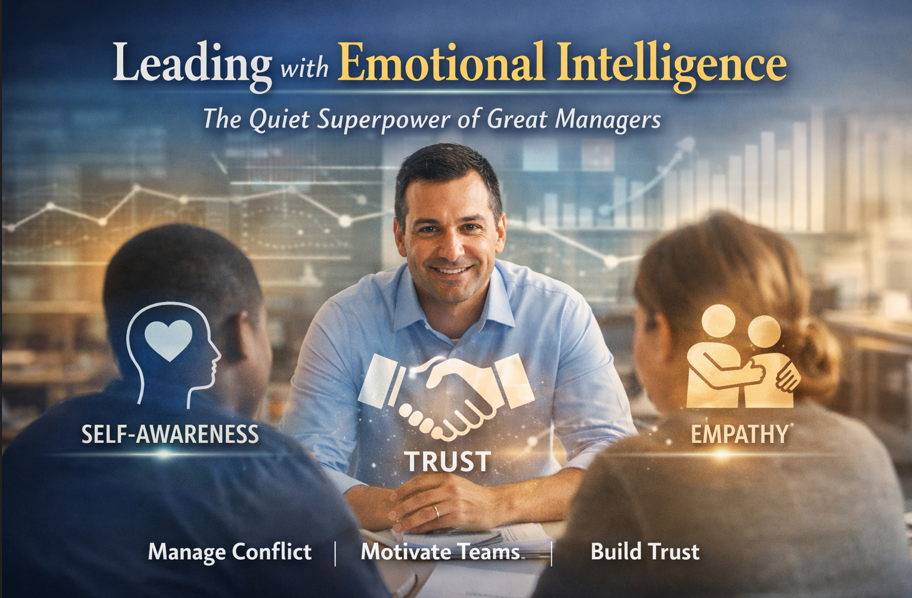
Emotional intelligence, first made popular by psychologist Daniel Goleman, is not a single trait; it is a set of skills that can be developed with intention and practice. Self-awareness is the foundation. It involves recognizing one’s emotional triggers, blind spots, and habitual responses. Managers who are self-aware understand how their mood, tone, and stress levels influence the team. This awareness allows them to pause and choose more effective responses.
Mona’s approach required no formal authority or policy change. By applying emotional intelligence, self-awareness, empathy, and thoughtful relationship management, she addressed the root of the conflict rather than its symptoms, strengthening both team culture and results.
Empathy goes beyond being kind or agreeable. It is the ability to understand another person’s perspective and emotional context without immediately trying to fix or dismiss it. Empathetic managers ask better questions, listen more deeply, and respond in ways that validate concerns while still holding standards.
Relationship management brings self-awareness and empathy into action. It includes giving feedback constructively, managing difficult conversations, resolving conflict, and motivating individuals in ways that align with their values and strengths.
Using EI to Navigate Conflict and Build Trust in any Sector
Conflict is inevitable in any team, but emotionally intelligent managers approach it as information rather than threat. Instead of escalating tension or avoiding discomfort, they seek to understand what is driving the disagreement.
An Emotionally Intelligent-driven approach to conflict includes focusing on shared goals rather than winning arguments. When team members know their manager will listen, remain fair, and respond thoughtfully, they are more likely to engage fully, raise concerns early, and collaborate effectively.
Motivating Teams Through Emotional Intelligence
Motivation is deeply personal. What energizes one team member may overwhelm another. Emotionally intelligent managers recognize these differences and adjust their approach accordingly.
Rather than relying solely on incentives or pressure, EI-driven leaders:
- Connect work to meaning and purpose
- Recognize effort as well as outcomes
- Provide feedback in ways that encourage growth rather than fear
- Create environments where people feel respected and valued
This form of motivation is more sustainable and often leads to higher engagement and retention. The most effective managers treat EI development as an ongoing practice rather than a one-time exercise.
The Takeaway
Emotional intelligence is not a soft skill; it is a leadership capability with real impact. In a world of increasing complexity, uncertainty, and diverse teams, the ability to understand and manage emotions is a defining advantage. Great managers are not those who control every outcome, but those who create conditions where people can perform at their best. Emotional intelligence is the quiet superpower that makes that possible.
What practical steps can you take over the next month to strengthen your own emotional intelligence as a manager?
Author Bio
Dr. Jalene Jacob brings together clinical acumen, strategic management and system design to drive meaningful, sustainable improvements in healthcare. She is committed to healthcare innovation and organizational excellence, with a focus on value-based care for population health improvement.